

Engineered Interlayers to Protect Your Overlay
SAMI (Stress Absorbing Membrane Interlayer) and ARI (Anti-Reflective Interlayer) are preventive interlayer systems used beneath overlays to absorb stress, minimize movement transmission, and delay reflective cracking — one of the leading causes of premature pavement failure.
SAMI is a thin PMB-based spray-applied membrane placed between aged bituminous layers and new overlays. It acts as a flexible cushion that absorbs load stress and thermal stress from the base layer — helping the overlay last longer without developing surface cracks.
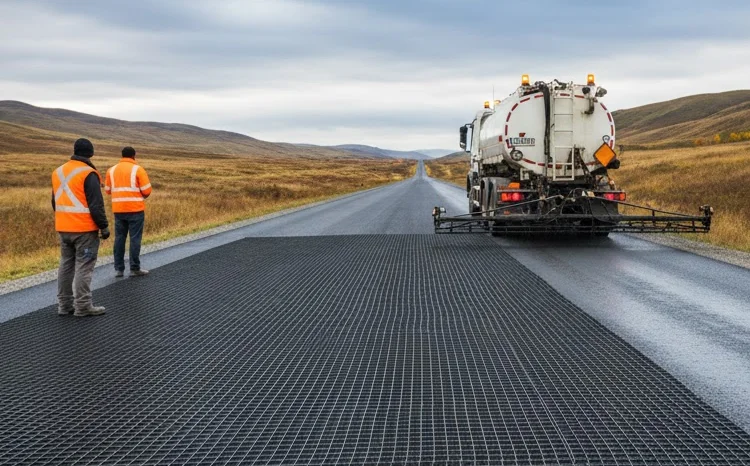
ARI is applied when a bituminous overlay is constructed on top of a rigid (concrete) pavement. In this case, the movement at joints or cracks in the concrete base is highly likely to reflect upward into the overlay.
At Ooms, ARI is implemented using Ooms GlassGrid Reinforcement — a high-strength, self-adhesive fiberglass grid that the upward propagation of reflected cracks from underlying layers. Combined with proper joint treatment and a tack coat, the GlassGrid becomes a load-distributing, crack-arresting interlayer within the overlay.

Whether it’s a flexible or rigid base, we offer end-to-end delivery of interlayer systems, backed by:
We don’t just apply membranes or grids — we engineer the layers between your pavement and problems.
| Existing Pavement | Overlay Type | Recommended Solution |
|---|---|---|
| Aged asphalt with cracks | Bituminous | SAMI |
| Rigid concrete pavement | Bituminous | |
| Movement-prone subgrades or RAP base | Bituminous |


Our interlayers work behind the scenes — so your overlays stay strong on the surface.

