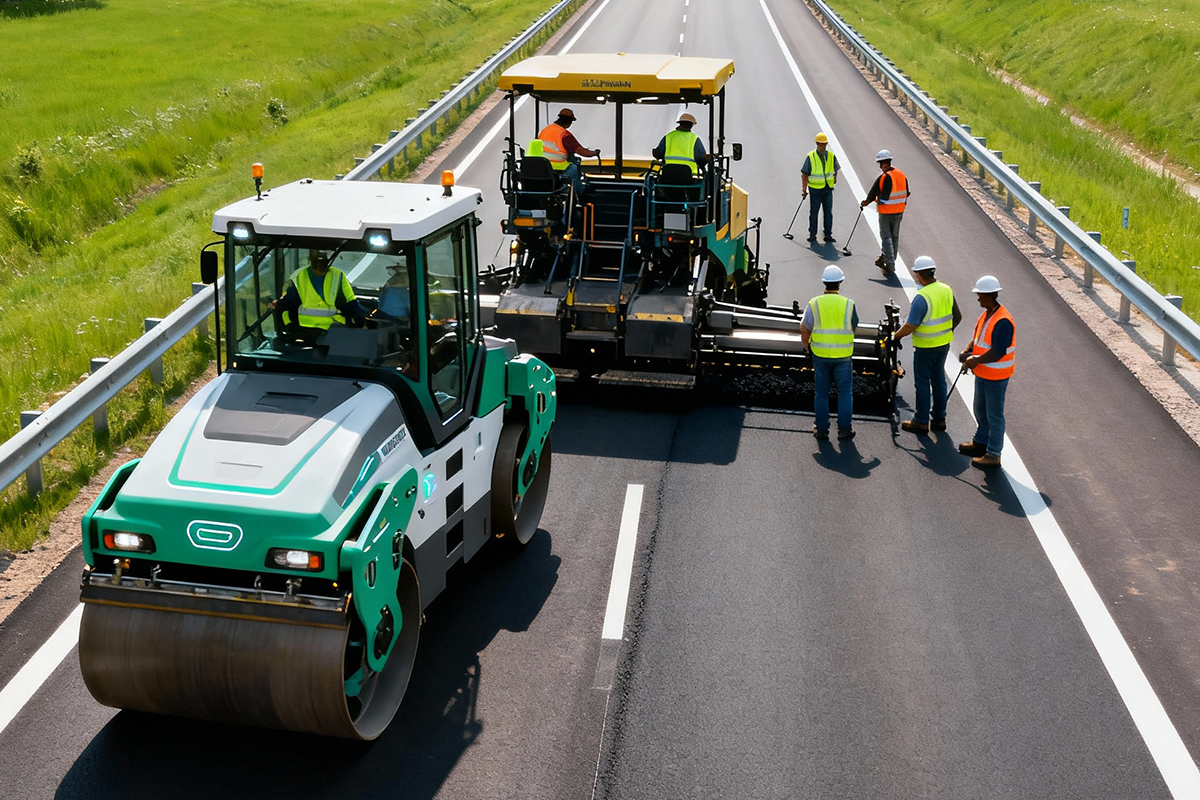

As India’s aviation sector continues to grow rapidly, airport infrastructure demands have reached an unprecedented level. One of the leading international airports in the country approached Ooms Avenhorn Holding India Pvt. Ltd. with a critical challenge: the existing runway pavement was showing significant signs of distress — including rutting, cracking, and surface fatigue — all of which could impact safety and operational efficiency.
The airport required a next-generation pavement solution that would not only restore the runway’s performance but also extend its lifespan, reduce maintenance cycles, and comply with international aviation standards.
This project became a testament to Ooms India’s engineering excellence, European-grade technology, and commitment to sustainable infrastructure innovation.

The airport’s main runway was exposed to:
High aircraft load intensity — including wide-body international aircraft weighing over 300 tons.
Extreme temperature variations, ranging from scorching daytime heat to cool nighttime conditions.
Tight maintenance windows, as the runway could not be closed for long periods without disrupting flight operations.
The challenge was to deliver durable performance under extreme operational stress — all while ensuring minimal downtime and adherence to aviation safety protocols.
Ooms India adopted a multi-layered engineering strategy combining material innovation, performance optimization, and efficient project management. Our in-house R&D team collaborated closely with Dutch experts from Ooms Netherlands to design a custom polymer-modified bitumen (PMB) blend optimized for Indian climatic conditions.
This innovative binder formulation enhanced resistance to rutting, oxidation, and fatigue, providing a more elastic and durable pavement structure.
In addition, the team employed Warm-Mix Asphalt (WMA) technology — a process that allows asphalt to be mixed and compacted at lower temperatures. This reduced emissions during production and minimized fuel consumption by nearly 30%, aligning with sustainable construction practices.
The project execution demanded precision and speed. The work was planned in tightly controlled night-time slots to avoid interference with airport operations. Advanced paving machinery and laser-guided compaction equipment were deployed to ensure perfect smoothness and uniformity.
Our team utilized infrared thermographic scanning during laying to monitor temperature uniformity — a key factor in achieving long-term performance. Laboratory testing was conducted simultaneously to validate material compliance and ensure consistency in bitumen properties.
30% increase in pavement lifespan compared to traditional materials
Zero operational downtime during construction
Enhanced surface friction and skid resistance, ensuring greater aircraft braking safety
Optimized binder elasticity that minimizes surface cracking
Reduced CO₂ emissions through Warm-Mix technology
Post-construction assessments revealed that the newly resurfaced runway outperformed all previous benchmarks in durability, smoothness, and resistance to deformation. The project not only achieved all its objectives but also set new standards for airport pavement rehabilitation in India.
Airport authorities praised Ooms India for the quality, speed, and sustainability of execution — establishing the company as a preferred partner for aviation infrastructure projects across India.
This case highlights how Ooms Avenhorn Holding India Pvt. Ltd. successfully combined European expertise, Indian execution efficiency, and sustainability-focused technology to deliver world-class results.
The project reinforced Ooms India’s reputation as a trusted provider of advanced pavement technologies capable of transforming critical national infrastructure.